
Behind every "AI pet portrait" is face-swap technology, not pure AI generation. Here's how we actually make portraits — and why we tell you upfront.
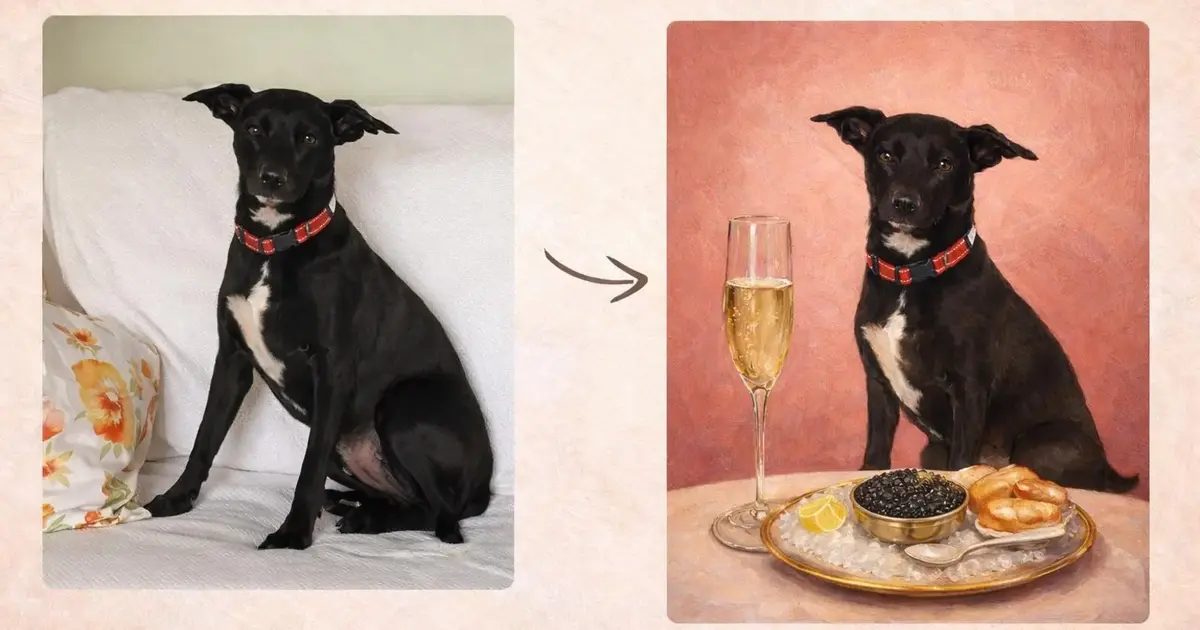
The Honest Answer: AI Pet Portrait Apps Don't Paint Your Pet From Scratch
If you've ever uploaded your dog's photo to a $19.99 AI pet portrait app and gotten a Renaissance-style oil painting back two minutes later, here's what actually happened: the app didn't paint your pet from imagination. It detected your pet's face, then swapped it into a pre-stylized template. Most apps don't tell you this part.
We're going to. We're create.petcanvas.art, the AI-assisted sister of petcanvas.art (human digital artists, the long way). Once you understand how the pipeline works, you'll know exactly what you're paying for and why some apps cost $5 and some cost $50.
What "AI Pet Portrait" Really Means: A Face Swap Pipeline, Not Magic
An AI pet portrait app works in four stages: it detects your pet's face, extracts identity features (eyes, nose, ear shape, fur pattern), pulls a stylized base scene painted in advance by digital artists, and composites your pet's face onto that scene using face-swap or facial inpainting. The final image is upscaled to print resolution before delivery. Pure text-to-image generation — the kind ChatGPT or Midjourney does — is rarely the main mechanism.
The 30-second version of what happens after you upload
You upload a photo. Within two minutes you get a portrait back. Here's the actual pipeline behind that:
- Detection. A computer vision model finds your pet's head, eyes, nose, and ears.
- Isolation. The model separates your pet from the background and any humans in the frame.
- Template selection. Based on the style you picked (Royal Velvet, Caravaggio Twilight, etc.), the system pulls a pre-painted canvas created in advance by digital artists.
- Face transfer. Your pet's face — proportions, eye color, fur pattern — gets composited onto the template's pose and costume.
- Color matching. The AI adjusts shadows, highlights, and temperature so the swap doesn't look pasted on.
- Output. You see a watermarked preview. If you like it, you pay; if you don't, you don't.
Why this is closer to Photoshop than to DALL-E
If you've watched a digital artist on YouTube spend three hours photoshopping a corgi's face onto a Renaissance noble painting, you've seen the human version of this process. The composition, costume, and lighting all exist already — the artist's job is to swap the face in convincingly. A trained model does the same swap in 90 seconds.
Pure AI generation is different. When you ask Midjourney to "paint my dog as a knight," it dreams up everything: the dog, the armor, the background, the lighting. The dog won't look like your dog. It'll look like a generic dog the model invented. That's why pure-generation pet portraits often disappoint.
The technical layer (in plain English)
You may have seen terms like IP-Adapter, ControlNet, facial inpainting, or identity preservation in AI image discussions. IP-Adapter tells the model "this is the face that must end up in the output." ControlNet locks in pose and proportions so your golden retriever stays a golden retriever. Facial inpainting paints inside a masked region (your pet's head area) without touching the rest of the canvas. Together they're the difference between a portrait that looks like your pet and a portrait of some dog.
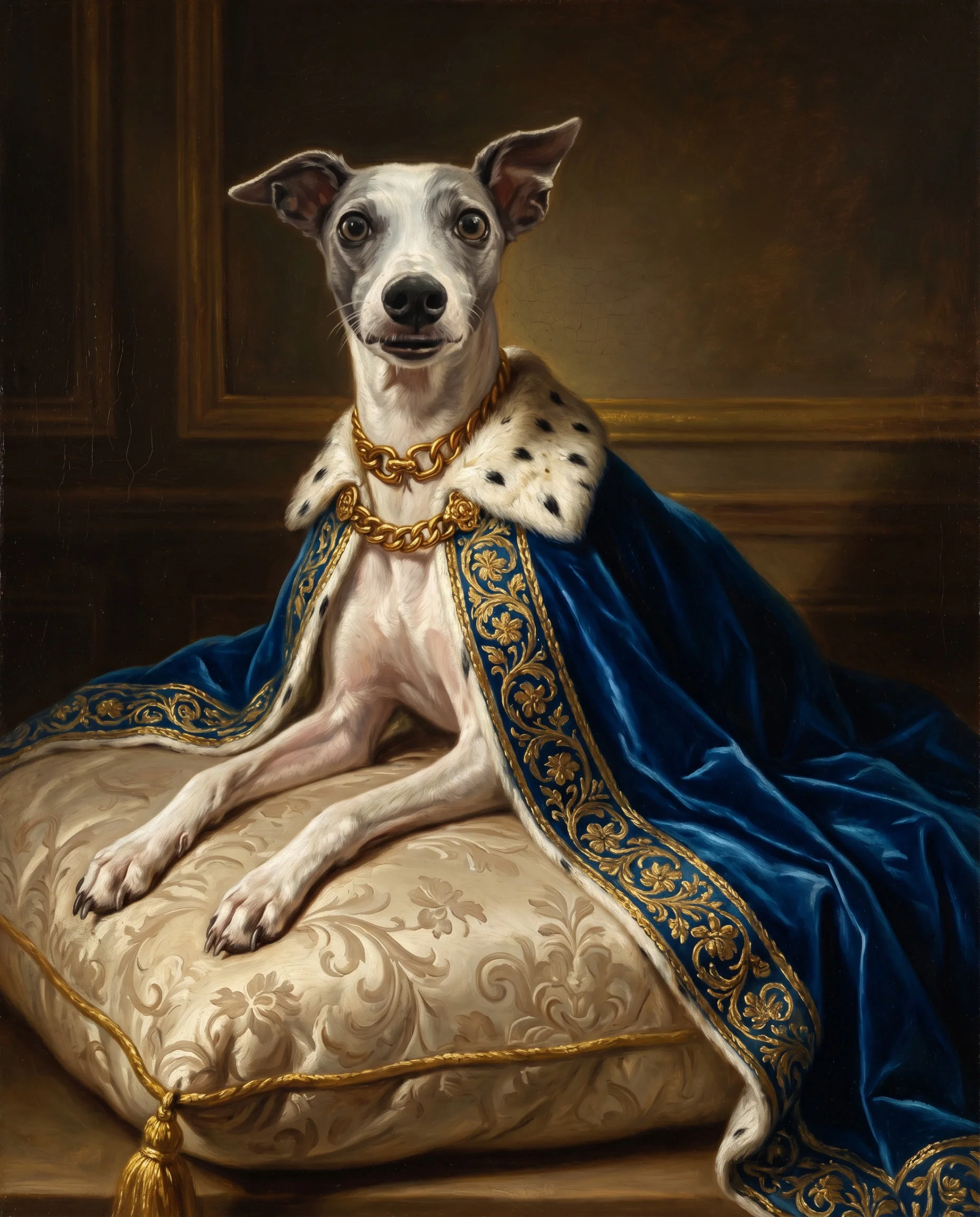
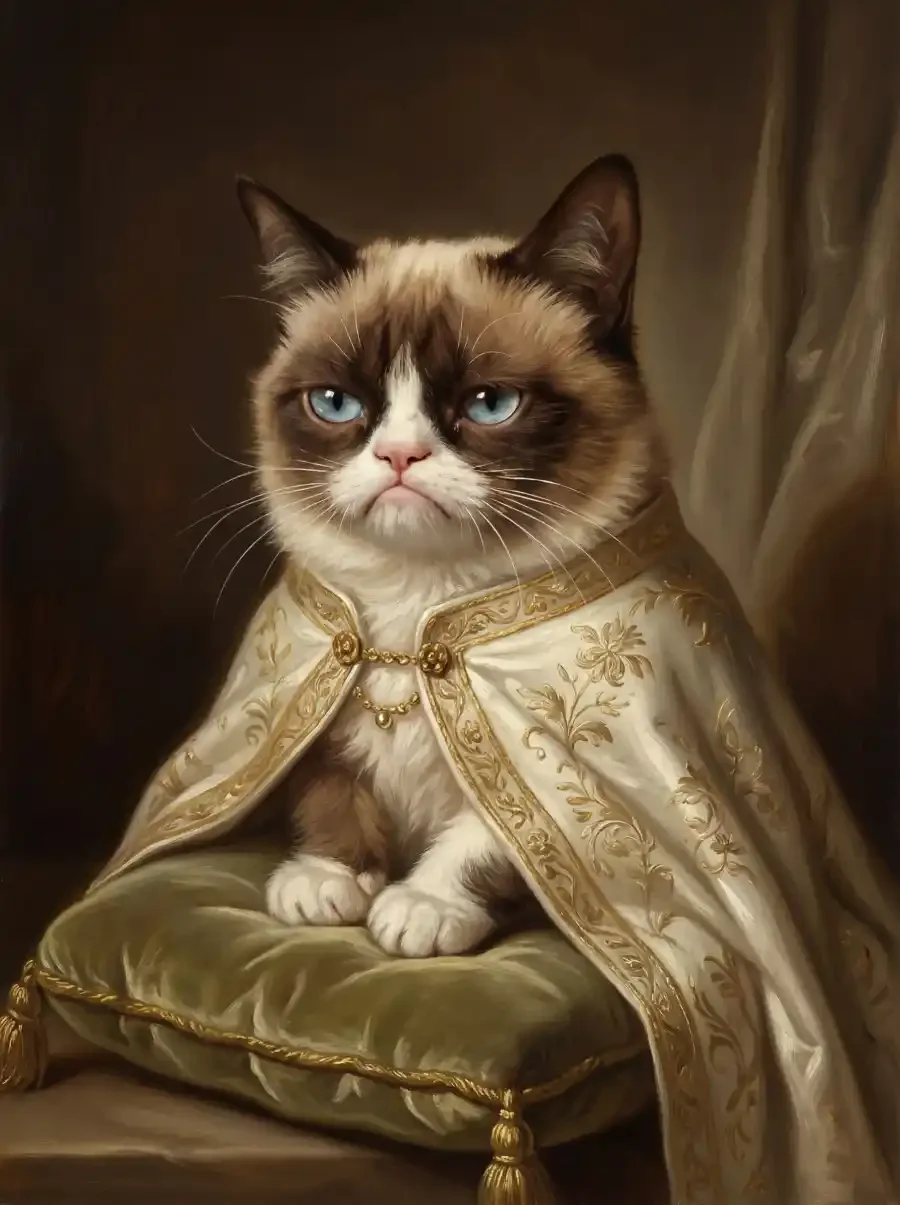
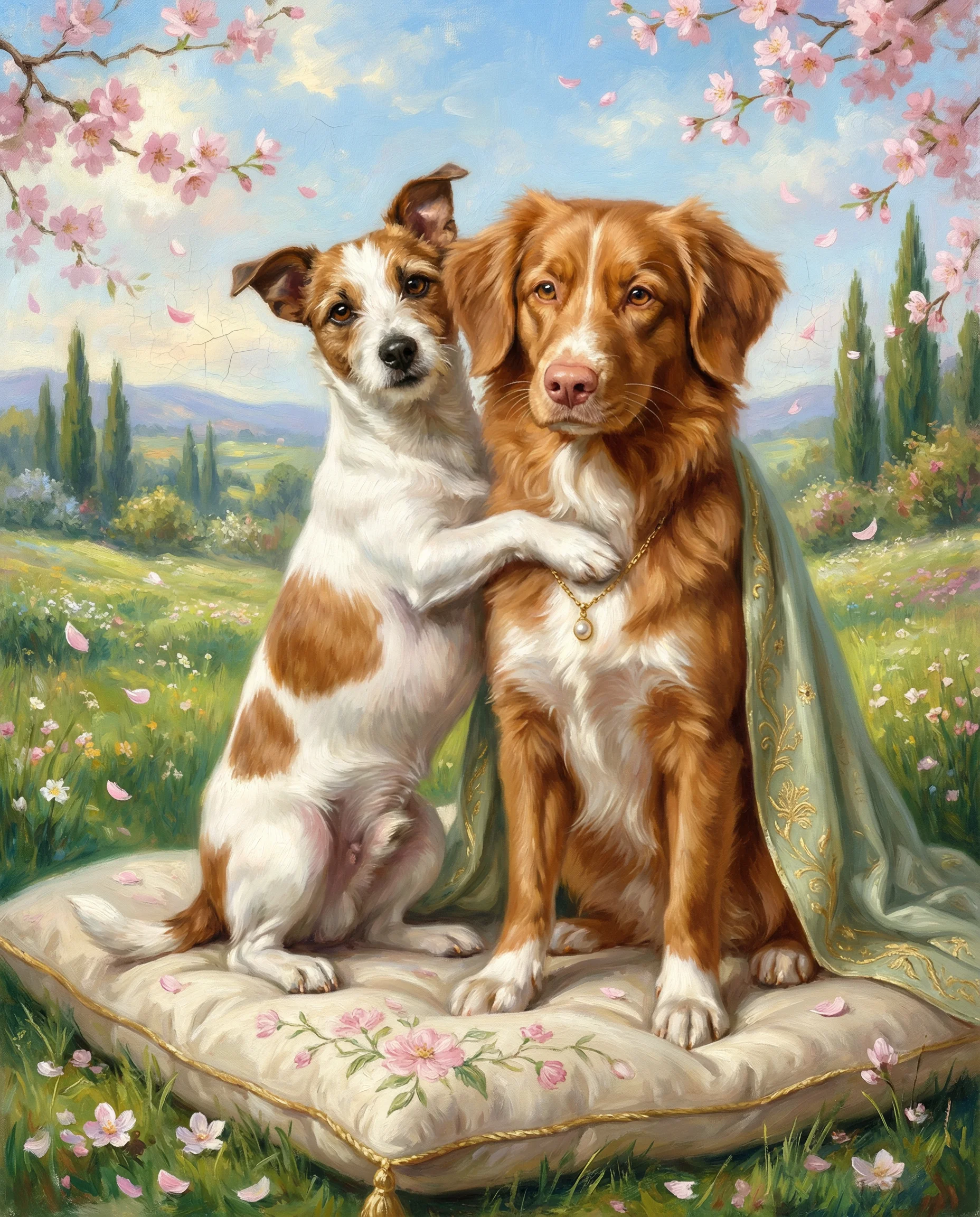
Face-swap pipeline vs pure AI generation
| What it does | Face-swap pipeline (us) | Pure AI generation (Midjourney/DALL-E) |
|---|---|---|
| Uses your real pet's face | Yes — detected and transferred | No — invents a pet from prompt |
| Looks recognizably like your pet | Usually yes | Hit-or-miss, often no |
| Pre-painted style template | Yes — by digital artists in advance | No — generated from scratch each time |
| Generation time | ~2 minutes | 30 seconds to 2 minutes |
| Cost per output | $19.99 digital | Free to ~$10/month subscription |
| Print-ready resolution | Yes — HD output | Sometimes, with upscaling |
Why We're Open About How This Works (When Most Apps Aren't)
Most AI pet portrait apps market themselves like a magic box: upload, magic happens, oil painting appears. That framing trains people to be disappointed later — when they realize what they paid $19.99 for is "really just face-swap technology," they feel tricked, even though the output is exactly what we delivered.
Flip side of the same problem: a few well-known services lean hard on "expert designers" and "proprietary editing techniques" without ever using the words AI, machine learning, or face-swap. That framing implies a human hand-painted each portrait. In reality, the underlying tech is the same family of tools — they just don't say so.
Here's why the transparency matters for you:
- Your pet's face is what gets preserved. With a clear photo, the result will look like your pet. That's the entire bet.
- The costume and setting aren't unique to you. Customers who pick Royal Velvet get the same base template with their pet's face. The style is shared; the pet is yours.
- Pricing makes more sense now. You're paying for the style template library, detection-and-blend technology, and the print pipeline — not for "an AI that paints from scratch."
- You decide if it's worth $19.99. A portrait that looks like your pet in a beautifully painted Renaissance setting for the price of a takeout dinner is a fair trade for most owners. You get to decide knowingly.
The Sustainability Problem: Why Most AI Pet Portrait Sites Vanish in a Year
Open any pet portrait Facebook group and you'll see the same complaint every few months: "Did anyone get their order from [X AI portrait site]? They stopped responding." There's a reason this keeps happening. The economics of pure-AI pet portrait sites are brutal, and most of them aren't built to last.
The economics behind disappearing sites
A pure-AI pet portrait site usually runs on a model API that charges per generation. Margins are thin. When ad costs go up, the math breaks. The operator either raises prices, cuts corners on output quality, or — most commonly — stops paying for support while still taking orders. A few months later, the site is a graveyard with no checkout and a Trustpilot page full of one-star reviews.
Face-swap pipelines like ours have better economics: the expensive part (style template painting) is a one-time cost, not a per-order cost. Once we commission the Royal Velvet template, it serves thousands of customers. That's why we can price digital at $19.99 and stay in business.
Why we built this differently
create.petcanvas.art exists because of petcanvas.art — our flagship site where human digital artists hand-make portraits the slow, expensive way. Pet Canvas existed before the AI wave. The AI app is the affordable, fast lane for people who want a great portrait without the $200+ commission.
Look, that structure matters. We're not a venture-funded startup that needs 10x growth or bust. We're a portrait business that added an AI lane. If the tools get better next year, we use better tools. If they get worse, we still have a portrait business. Most flash-in-the-pan AI pet portrait sites can't say that.
Where Does the Face-Swap Pipeline Work Best, and Where Does It Struggle?
Face-swap pet portraits work best when you upload a clear, well-lit, eye-level photo of one pet with their face roughly forward. They struggle with multiple pets in one frame, extreme angles, dark or blurry photos, and unusual fur patterns the detection model hasn't seen often. Photo quality is the single biggest variable in how recognizable your final portrait will be.
- Single pet in the frame (multi-pet portraits exist but split into separate uploads work better)
- Natural daylight, no harsh flash
- Pet's eyes visible and roughly looking at the camera
- Photo taken at the pet's eye level, not from above
- Background isn't busy — a plain wall or floor is ideal
- No human hands or arms covering the pet's body
Edge cases we're honest about
Some pets and photos just don't play well with detection models: extremely fluffy faces where eyes are hard to find, all-black pets in low light, motion blur, photos taken through a phone screen, and unusual breeds the training data underrepresents. If your first preview doesn't look right, try a different photo. Nine times out of ten, the photo is the variable.
Single-shot vs multi-shot pipelines
If the same prompt on a free AI tool gives you two different-looking pets, you hit a single-shot pipeline — one photo, one pass, varying output. Multi-shot pipelines ask for 5-10 photos and fine-tune a small model on your pet before generating, producing more consistent likeness at higher cost and longer turnaround. We use single-shot with strong identity-preservation (the IP-Adapter family) because it's the right balance for $19.99. Multi-shot custom models are the $50+ option for hyper-consistent results.
The Human + AI Direction: Where We're Taking This Next
Pure AI is hitting a ceiling — pet portrait quality plateaued in late 2025, and the cheap shortcuts (generic poses, samey lighting) are getting more obvious. The next leap isn't more AI; it's better human-in-the-loop integration: digital artists reviewing tricky outputs and fixing detection errors.
That's where Pet Canvas is heading. The AI app stays affordable and fast for the 90% of cases where the pipeline produces a great result. For the trickier 10% — or customers who want hand-finished detail — there's a path to human-artist refinement. AI alone isn't the destination. Human + AI is.
Common Misconceptions People Have About AI Pet Portraits
The misunderstandings below come up in pet owner groups and customer service tickets every week. Most of them are the result of bad marketing across the industry, not bad customers.
Misconception 1: "It's just a filter on my photo"
It isn't. Photo filters apply uniform effects (blur, color shift, oil-paint texture) on top of your existing image. A face-swap pipeline replaces the body, background, and composition entirely while preserving your pet's facial identity. Side by side, it's obvious.
Misconception 2: "It's pure DALL-E or Midjourney"
For most paid AI pet portrait services, no. Pure generation invents the pet. Face-swap preserves your real pet. Some apps mix both — generation for backgrounds, swap for the face. We use swap because pet recognizability is the only thing that matters in a pet portrait.
Misconception 3: "Real digital artists hate this technology"
Some do, some don't. Honestly, the artists we work with at Pet Canvas have mixed feelings on this, and that's fair. Face-swap pipelines compress a three-hour Photoshop job into 90 seconds — and that changes the economics of a market artists used to own. We're not pretending the conversation isn't messy.
Misconception 4: "My pet won't actually look like my pet"
With a good photo, your pet will look like your pet. The face-swap step preserves what makes your pet identifiable — eye color, ear shape, fur pattern, nose, expression. What changes is the body pose, costume, and setting. If the preview doesn't look right, the photo is almost always why.
Frequently Asked Questions
Is an AI pet portrait actually "real art"?
It depends on your definition. The style templates were painted by digital artists — real art. The face-swap step is compositing — a technical process. The final portrait sits between a digital artist's work and a Photoshop job. We won't pretend the AI invented the painting.
Is using a face-swap pipeline for pet portraits ethical?
The ethics conversation in AI art mostly centers on training-data consent. Our style templates are commissioned originals owned by Pet Canvas — not scraped from non-consenting artists. Face-swap technology itself is the same family as the mainstream photo apps everyone uses. To be fair, we think we're on the right side of this; we're open to being told otherwise.
Will my pet actually be recognizable in the final portrait?
Yes, almost always. The point of face-swap over pure generation is preserving your pet's specific features. If a preview doesn't look like your pet, try a clearer, more eye-level photo. Photo quality is the biggest variable.
How is this different from generating a pet image with ChatGPT or Midjourney?
ChatGPT and Midjourney invent the entire image from your prompt — the pet they generate isn't yours, it's the model's guess at "a golden retriever." Face-swap starts with your real photo and keeps what makes your pet identifiable. The output looks like your dog, not "a dog."
What happens to my pet's photo after I upload it?
We store it temporarily to generate your portrait and any reprints you order later. We don't use customer pet photos to train our models. You can request deletion any time.
How long does it take to make an AI pet portrait?
About two minutes from upload to preview. Slower apps (5-10 minutes) usually do an extra upscaling pass or run on cheaper hardware. Faster apps (under 30 seconds) usually skip the upscale step, which shows up later as a blurry print.
Why do some AI pet portraits not look like my pet?
Three reasons, in order of frequency: the source photo was bad (poor lighting, off-angle, motion blur), the app uses pure text-to-image generation instead of face-swap, or the identity-preservation step was weak (no IP-Adapter, no ControlNet). Reason one is your job. Reasons two and three mean picking a service that uses a real face-swap pipeline.
Can I print and resell an AI pet portrait commercially?
For personal use, gifts, your own walls: yes. For commercial resale: check the specific license. Ours grants personal-use rights with the digital download; commercial rights need a separate license. Pure-generation AI outputs sit in a murky copyright zone — the US Copyright Office has ruled fully AI-generated images aren't copyrightable. Face-swap outputs that combine your photo with human-painted templates have clearer footing.
How much does a portrait cost compared to a hand-painted commission?
Digital download is $19.99. A hand-painted commission from a human digital artist typically runs $80-$300, with longer turnaround. If you want a deeper breakdown of when each is worth it, our custom pet portrait guide walks through the AI vs hand-painted decision in detail.
If you want to see the actual step-by-step on creating a portrait, our guide on turning a pet photo into a painting walks through the upload-to-print flow. For app comparisons, our 2026 AI pet portrait app roundup covers eight services we tested. This piece was about how the underlying technology actually works.
Turn Your Pet Into Art
Upload your pet photo, choose from dozens of artistic styles, and get a stunning portrait in minutes.
Create Your PortraitFree preview — try before you buy