
They told you it was just a dog. They were wrong. Here is how a memorial portrait shifts the last memory from a vet visit to the face you actually loved.
Pet Memorial Portrait: The Collar Is Still on the Hook
You haven't moved it yet. The leash is right where they left it — looped over the same hook by the door, the clasp still shaped to the curve of their neck. The water bowl is in the kitchen. You keep almost filling it.
A pet memorial portrait won't undo any of that. It won't bring back the weight on the bed at 3 a.m. or the sound of nails on hardwood when you open the fridge. But here's what it does — and what peer-reviewed grief research confirms: it gives your brain a different last image. Not the veterinary table. Not the IV line. The face. The actual face, the way they looked at you when you were the entire world.
That shift matters more than most people understand. And if you're reading this at 2 a.m. with swollen eyes, I want you to know: what you're feeling isn't dramatic. It isn't an overreaction. It's one of the most well-documented forms of grief in clinical psychology — and it's real. (If you're new to pet portraits in general, our complete guide to custom pet portraits covers styles, sizing, and what to expect.)
"It Was Just a Dog" — And Other Lies People Tell You
You've heard it. Maybe from a coworker who shrugged when you called in sick. Maybe from a family member who said "you can always get another one" like you were talking about a broken coffee maker. Psychologists have a name for what happens next: disenfranchised grief — the kind of mourning that society doesn't give you permission to do.
But the research says society is wrong.
- 7.5% of pet owners who lose an animal develop prolonged grief disorder — the exact same rate as losing a grandparent or close friend (PLOS ONE, 2026)
- 30% experience intense, debilitating grief in the weeks after loss (Bridgewater State University)
- 21% of people who experienced both human and pet loss said losing the pet was more distressing
- At the two-week mark, grief scores for pet loss are statistically identical to grief scores for human loss (Gerwolls & Labott, 1994)
Read those numbers again. One in five people found losing a pet harder than losing a person. Not because they loved people less — but because nobody gave them a funeral, bereavement leave, or even a casserole. The grief had nowhere to go.
And a memorial portrait doesn't replace a funeral. But it does something a funeral does: it says this mattered. It takes the love that's crashing around inside you with no outlet and gives it a frame. Literally.
Can a Portrait Actually Shift How You Grieve?
Yes. And the mechanism is simpler than you'd expect.
The Last Memory Problem
Right now, if you close your eyes and think of your pet, what image comes up? For most people in acute grief, it's the end. The car ride to the vet. The waiting room. The moment you knew.
Psychology Today documents this pattern extensively: the final traumatic image hijacks memory, overwriting years of joy with a single terrible afternoon. Grief therapists call it "memory narrowing" — your brain fixates on the ending because it's trying to process the shock.
But a portrait interrupts that loop. It puts a different image on your wall, your phone screen, your desk — the face they made when you came home, when you opened a treat bag, when they fell asleep in a sunbeam. Over time, that becomes the dominant memory. Not erasing the end. Just refusing to let it be the only thing.
Art as Grief Processing — It's Not Woo
The Cleveland Clinic has published research showing that engaging with art — even passively, even just looking at a meaningful image — measurably reduces cortisol and helps the brain shift from fight-or-flight mode into processing mode. You don't need to paint the portrait yourself. You just need something that holds the emotion outside your body for a while.
Academic research confirms this through what psychologists call "continuing bonds" theory — the idea that maintaining a symbolic relationship with someone you've lost isn't denial, it's healthy and well-documented healing. A portrait on the wall is a continuing bond. It says: you're still here, in this house, in this family.
Why Waiting Six Weeks for a Painting Makes Grief Worse
Here's what nobody in the handmade portrait industry wants to talk about: timing.
Grief is most acute in the first 48 hours. The emptiness is loudest when the house first goes quiet. That's when the brain is most desperate for something to hold onto — and that's precisely when every traditional portrait service says "please allow 4-6 weeks for completion."
Six weeks. While the collar is still on the hook.
And that's before you factor in revisions, shipping delays, or the artist ghosting you entirely — which, based on what we've seen in Etsy reviews and pet loss forums, happens more than the industry admits.
| Service | Type | Memorial Options | Wait Time | Price |
|---|---|---|---|---|
| West & Willow | Digital print | Halo, wings (extra) | 2-4 weeks | $89+ |
| Crown & Paw | Digital print | Puppy-to-adult combo | 1-3 weeks | $79+ |
| Etsy handmade artists | Hand-painted | Custom (ashes, paw prints) | 4-8 weeks | $120-300 |
| Paint Your Life | Hand-painted oil | Any style | 2-3 weeks | $189+ |
| Pet Canvas AI | AI + human curation | Heavenly Paradise (wings, halo, garden) | 2 minutes | $19.99 |
I'm not saying handmade art doesn't have value — it absolutely does, and if you want a hand-painted oil portrait by a real human artist, our sister studio petcanvas.art works with professional digital artists who create stunning commissioned pieces. That's a different process, a different timeline, and a different kind of beautiful.
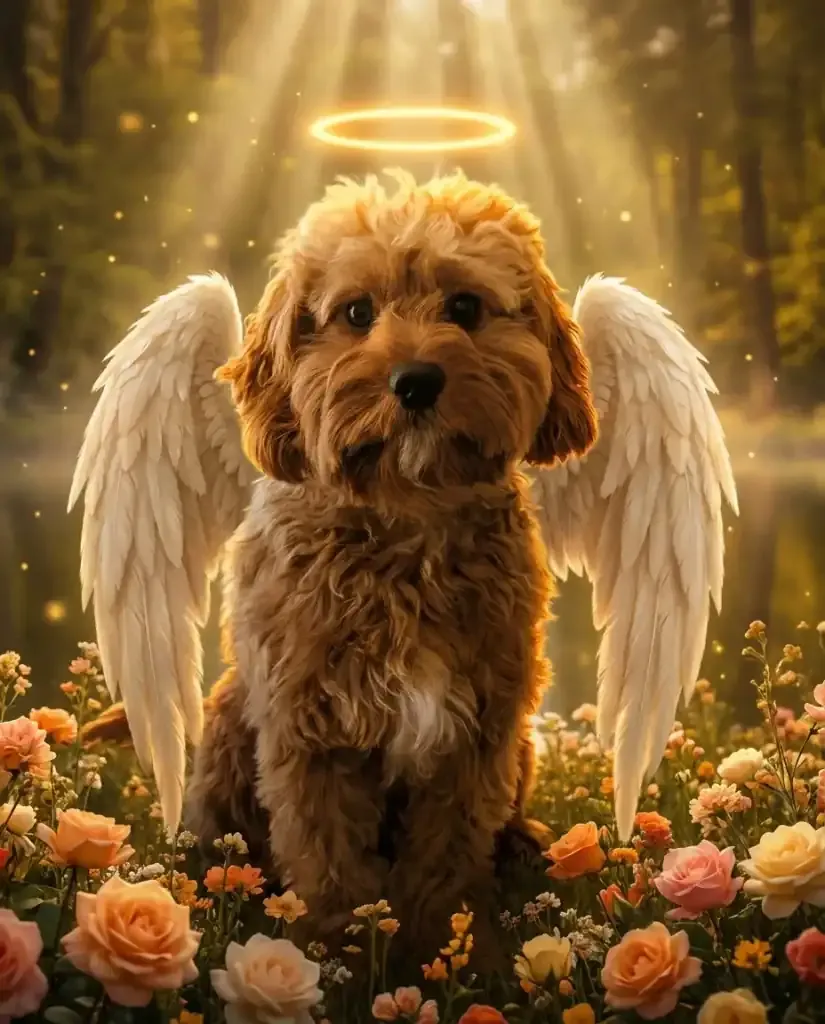
But when grief is raw and you need something now — not in six weeks when the sharpest edge has already dulled — that's what create.petcanvas.art was built for. Upload a photo, choose the Heavenly Paradise style, and in two minutes you're looking at your dog in angel wings against a golden garden that looks like the place you hope they are.
Preview is free. You don't pay unless it makes you feel something. And in our experience? It always does.
Choosing a Style That Matches Your Grief
Not all grief looks the same. Some people want celestial comfort. Some want quiet dignity. Some want to see their cat in a military jacket because laughing through tears is its own kind of medicine. Here are three styles we see chosen most for memorial portraits — and if you want even more inspiration, our 25 pet portrait ideas guide covers every room, occasion, and aesthetic.
Heavenly Paradise — "They're Somewhere Beautiful Now"
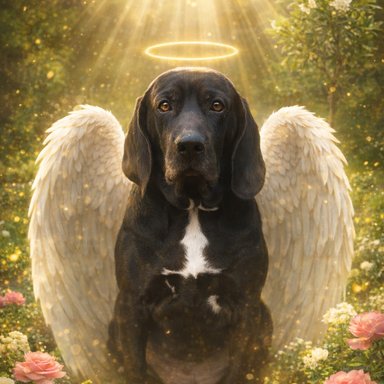
Angel wings. A golden halo catching light from somewhere above. A Renaissance paradise garden in full bloom behind them. This is the style people choose when they need to believe their pet is somewhere warm and safe. It's not subtle — it's not trying to be. It's a declaration: you deserved heaven, and this is what it looks like.
Works especially well for: dogs with soulful eyes (labs, goldens, spaniels), cats with regal posture, any pet whose photo captures them looking directly at the camera.
Caravaggio Twilight — "Quiet Remembrance"
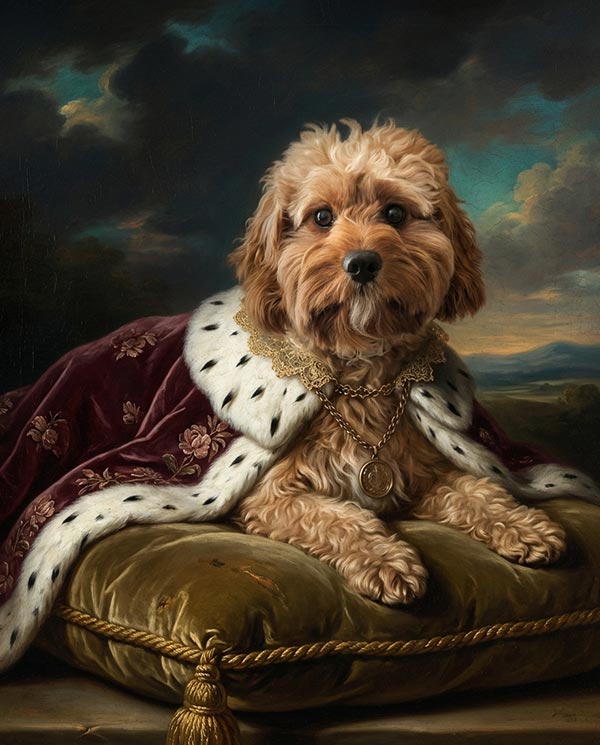
If Heavenly Paradise is a prayer, Caravaggio Twilight is a silence. Deep shadows, a single shaft of light illuminating their face, everything else falling into darkness. This is the style for people who grieve quietly — who don't want wings or gold, just the face, lit the way they remember it in late afternoon sun.
Works especially well for: dark-coated pets, black cats, brindle dogs — breeds whose features get lost in bright photography but come alive in chiaroscuro.
Royal Velvet — "They Ruled This House and We All Knew It"
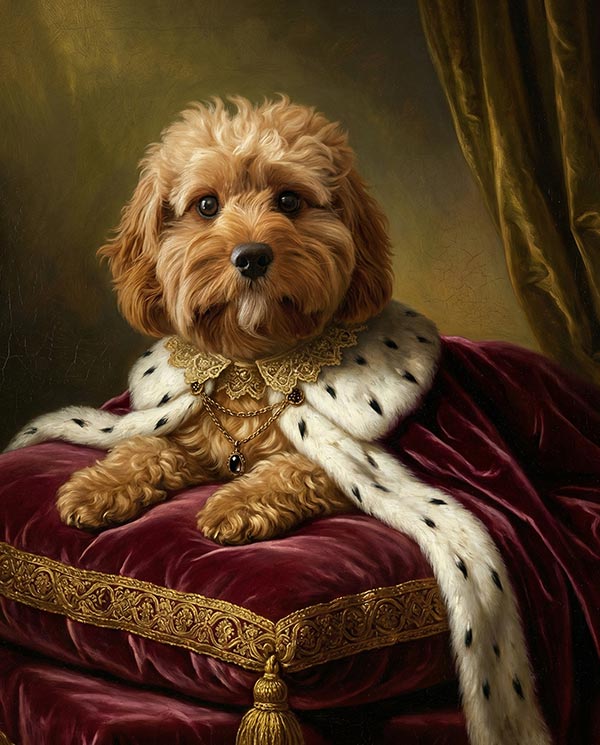
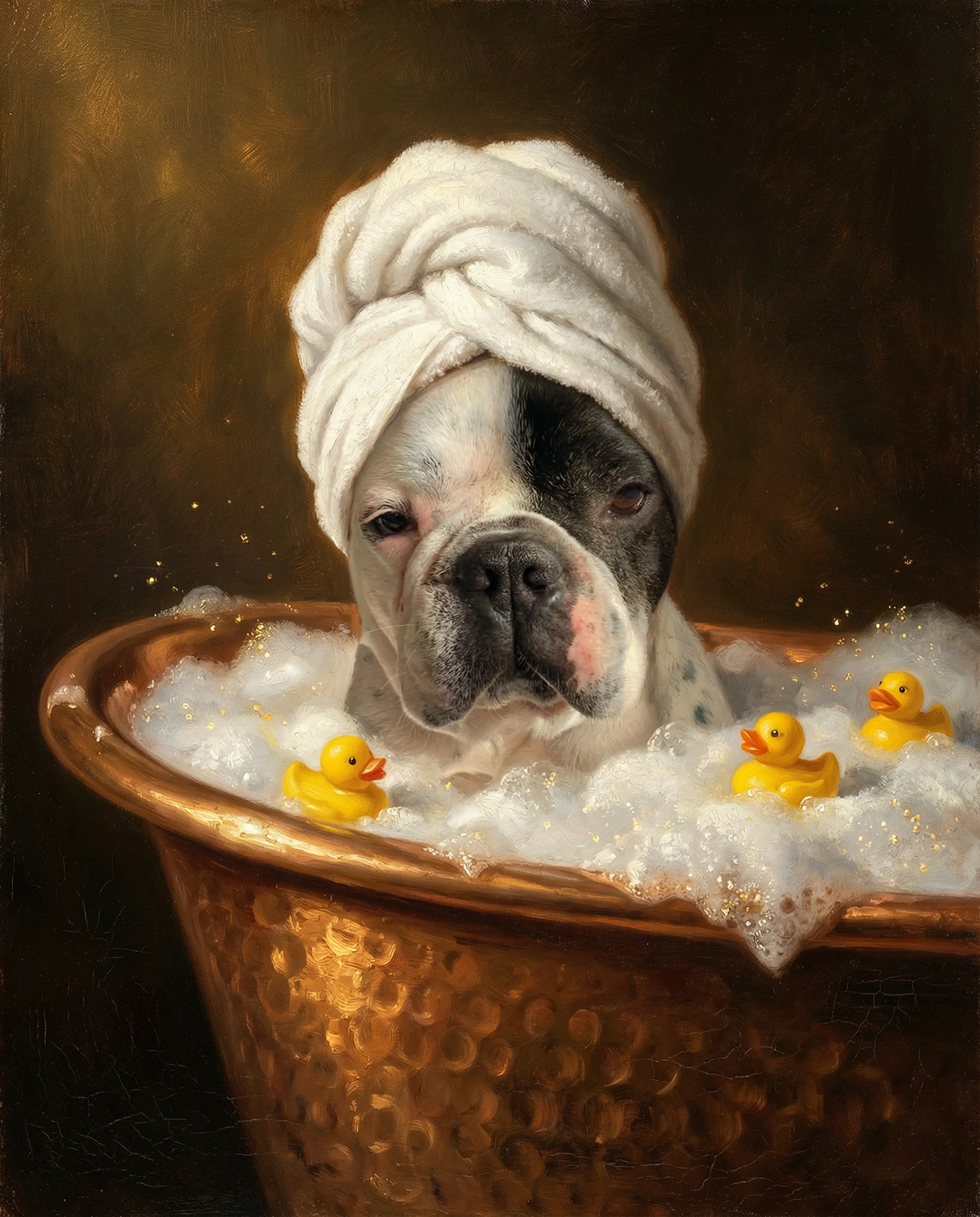
Velvet robes, a gilded background, the unmistakable look of a creature who knew they were in charge. Some people don't want sadness on the wall. They want to walk past and smile every single day — to remember the personality, not the loss. Royal Velvet is for them.
Works especially well for: cats (obviously), bulldogs, pugs, any pet whose defining trait was "attitude."
Five Mistakes That Turn a Tribute Into a Regret
We've generated thousands of memorial portraits. These are the patterns we see when people end up disappointed — and how to avoid them.
1. Waiting Until the Photos Degrade
Phone photos from 2016 are in a different resolution universe than phone photos from 2024. If your pet passed recently, use the most recent clear photo you have — ideally one where their face is well-lit and in focus. If you're working with older photos, that's fine too. AI handles grain and low resolution better than most human artists. But don't wait another year. Hard drives fail. Cloud accounts get deleted. Do it while the photos are accessible.
2. Choosing a Style for Aesthetics, Not Emotion
I've watched people spend twenty minutes toggling between styles trying to match their living room color palette. Stop. Choose the one that makes you feel something when you see it. The "right" style isn't the one that matches your sofa — it's the one that makes you catch your breath.
3. Over-Personalizing With Text
Names, dates, "Forever in My Heart" — we understand the impulse. But text turns art into a plaque. The most powerful memorial portraits are the ones that are purely visual. The portrait holds the emotion; the dates live in your memory. If you want text, put it on the frame or the wall beside it. Let the portrait breathe.
4. Springing It on a Grieving Person Too Soon
This one comes straight from pet loss communities online. A well-meaning friend orders a portrait and gifts it three days after the loss — and the recipient breaks down, but not in the healing way. In the "I wasn't ready" way. If you're buying a memorial portrait as a gift, offer the gesture first. "I'd love to do this for you when you're ready." That single sentence changes everything.
5. Keeping It Digital Only
A digital portrait on your phone is nice. A printed portrait on your wall is a memorial. There's a psychological difference between scrolling past something and walking past something every day. Pet Canvas offers canvas and framed print options specifically because grief needs physical space — not just screen space.
FAQ
Can I get a memorial portrait of a pet that passed away years ago?
Yes. All you need is one clear photo where their face is visible. It doesn't matter if the photo is from a phone, a digital camera, or even a scanned print. We've created memorial portraits from photos taken over a decade ago. The AI processes the image and generates a full portrait in the style you choose — Heavenly Paradise, Caravaggio Twilight, Royal Velvet, or any of our 20+ styles. There's no time limit on when you can honor them.
How much does a pet memorial portrait cost?
At create.petcanvas.art, a digital pet memorial portrait costs $19.99. Preview is free — you only pay if you love the result. Printed canvas starts from $49.99. By comparison, handmade memorial portraits from services like West & Willow start at $89, Crown & Paw at $79, and commissioned oil paintings on Etsy range from $120 to $300+.
What if I only have one blurry photo of my pet?
One photo is enough. AI portrait generation works with a single image, even if it's not studio quality. The algorithm focuses on facial structure, markings, and coloring. A slightly blurry photo will produce a slightly softer result, but the resemblance holds. For best results, use a photo where the pet's eyes are visible and the face isn't obscured by shadows or objects.
Can I add angel wings or a halo to the portrait?
The Heavenly Paradise style includes angel wings, a golden halo, and a lush paradise garden background by default — no customization needed. Just upload your photo, select Heavenly Paradise, and the portrait generates with all celestial elements included. It's our most popular choice for memorial portraits.
Does a pet memorial portrait actually help with grief?
Research supports it. The AVMA recommends visible memorials as part of healthy grieving. "Continuing bonds" theory — maintaining a symbolic connection with a lost loved one — is well-documented in psychology as beneficial rather than avoidant. Many pet owners report that having a portrait on the wall shifts their dominant memory from the final vet visit to the living, breathing personality they loved.
If you're ready — or even just curious — upload a photo and see a free preview. You don't owe anyone an explanation for how much this hurts. And you don't need to wait six weeks to do something about it.
If you'd prefer a hand-painted portrait created by a professional human artist with a personal touch, visit our sister studio at petcanvas.art — real artists, real brushstrokes, and the kind of collaboration that's its own form of healing.
Turn Your Pet Into Art
Upload your pet photo, choose from dozens of artistic styles, and get a stunning portrait in minutes.
Create Your PortraitFree preview — try before you buy